
Global Transportation Fund
Transportation should never be a barrier to childhood cancer treatment.
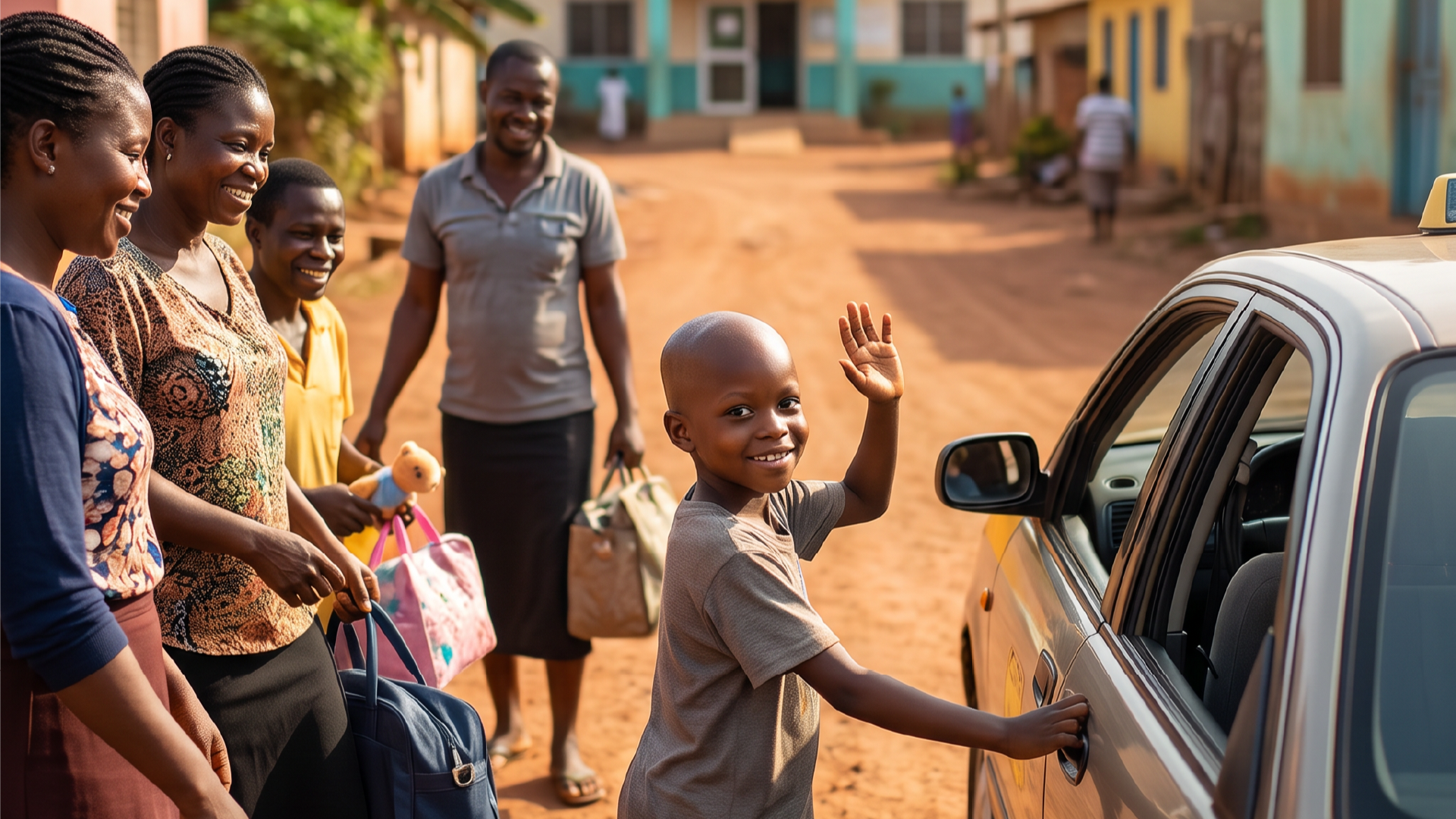
Life-saving treatment only saves lives if children can reach it. For many families, especially in low- and middle-income countries, reaching a specialised treatment centre is a challenge in itself. Long distances and transportation costs can lead to missed appointments, interrupted treatment, and treatment abandonment, ultimately reducing a child’s chance of survival.
The CCI Global Transportation Programme helps remove this barrier by supporting member organisations to provide safe, reliable and locally appropriate transportation for children with cancer and their caregivers.
Making the journey to treatment possible
Transportation needs look different in every community. That’s why the Global Transportation Programme supports locally led solutions, giving CCI member organisations the flexibility to respond to the realities of the families they serve.
Through grants, the programme supports:
Public transportation costs, including travel vouchers and reimbursements for families;
Dedicated vehicles to safely transport children and their caregivers to and from treatment; and
Operating costs, including fuel, maintenance and drivers, to keep transportation services running.
From helping a family pay for a bus journey to putting a dedicated vehicle on the road, the goal is the same: making sure children can get to treatment.
Who can apply?
The programme is open to eligible CCI member organisations in low- and middle-income countries, including upper-middle-income countries. Applicants must be in good standing and demonstrate a strong connection to a paediatric cancer treatment centre.
How to apply?
Applications are open until 16 October 2026, 23:59 CET.
Please review the Programme Guidelines, Application Form and FAQ before applying. Completed applications should be submitted by email to maia.fava@cci.care
Frequently Asked Questions (FAQ) - Application Guidance
This FAQ addresses the parts of the Programme Guidelines and Application Form that applicants most often find unclear. It does not replace the official Guidelines or Application Form — please refer to those documents for the full requirements.
-
Q: We are a CCI Associate Member, not a Full Member — can we still apply?
A: Yes. Both CCI Full Members and Associate Members can apply, as can organisations that have, at a minimum, been approved by the CCI Board. In all cases, your organisation must be in good standing (no outstanding fees) and your application must demonstrate a strong connection to a paediatric treatment centre and a proven programme of childhood cancer support.
Q: Our country is an LMIC but not in Sub-Saharan Africa, India or Brazil — can we still apply?
A: Yes. Priority is given to Sub-Saharan Africa, India and Brazil at the donor's request, but projects from other Low- and Middle-Income Countries (including Upper-Middle-Income, per the World Bank definition) are welcome to apply.
Q: Can we submit more than one contact person for the application?
A: No. Only one contact person (project lead) is allowed per application, and that person must be committed for the full duration of the grant.
-
Q: Can we apply for more than one project type (e.g. vehicle purchase AND operating costs)?
A: No. The Application Form asks you to choose ONE project type (Type A – Access to public transportation, Type B – Vehicle purchase, or Type C – Vehicle operating costs) per application.
Q: What currency should we use in the budget?
A: All amounts in the Application Form (Section 9, Budget Summary) must be expressed in Euros (€) only, even if your project costs are incurred in local currency.
-
Q: Can we adapt or reformat the Application Form template?
A: No. The template has a fixed format and cannot be modified. Applications must be submitted using the official template, completed in English, with all fields filled in.
Q: Do the 250–500 word limits on narrative sections (e.g. 4.1–4.3, 6, 7.2) apply strictly?
A: Yes. Each of these sections specifies a minimum and maximum word count (min. 250, max. 500 words). Responses that are much shorter may be seen as insufficiently developed, so aim to use the space to fully address the question.
Q: Do we need to complete Section 5 for all three project types?
A: No. Section 5 (Project-Specific Information) only requires you to complete the subsection matching the project type you selected in Section 3 — i.e. 5.1 for Type A, 5.2 for Type B, or 5.3 for Type C.
Q: The Implementation section (6) asks about vehicle logbooks — does this apply to us if we're only requesting Type A funding?
A: No. That specific question (vehicle use logging) is marked "Type B and C only." All other questions in Section 6 apply to every project type.
-
Q: Can supporting documents (quotes, invoices, letters) be submitted in our local language?
A: Yes. Supporting documents may be submitted in their original form and language. Where applicable, please also provide an English translation.
Q: For a vehicle purchase (Type B), how many supplier quotes do we need?
A: You must provide cost quotes from at least two suppliers, along with vehicle specifications, proof of organisational capacity to manage a vehicle (maintenance plan, insurance, driver arrangement), and written proof of donor commitments supporting the vehicle's ongoing running costs.
Q: What counts as "written proof of donor commitments" for sustainability?
A: This should be a signed letter or written confirmation from a donor or sponsor (local or otherwise) committing funds to support the project's continuation — particularly the ongoing running costs of a vehicle after the grant period ends. This is required for vehicle purchase projects and should also be referenced in the sustainability section of the form.
-
Q: What is a "unique beneficiary" and how is it different from the number of trips?
A: A unique beneficiary is an individual counted only once during the reporting period, no matter how many times they received support. For example, a child who takes 15 transport trips in a year still counts as 1 unique beneficiary, while those 15 trips are counted separately under "total trips provided."
Q: What's the difference between "immediate outcomes" and "intermediate outcomes"?
A: Immediate outcomes are quantitative data collected through regular reporting during implementation (e.g. number of beneficiaries, trips, distance travelled). Intermediate outcomes are qualitative data collected after project completion, through surveys and discussions with beneficiaries and healthcare professionals, covering things like perceived reliability, treatment adherence, and caregiver well-being.
-
Q: What happens if we submit our application after the closing date?
A: Applications submitted after 16 October 2026, 23:59 CET will not be reviewed. Applicants are strongly encouraged to submit well before the deadline: after the closing date, the CCI team and Working Group will not ask for or accept any missing documents, and incomplete applications will be disqualified.
Q: How and where do we submit the application?
A: By email to maia.fava@cci.care, with all required documents attached, using the subject line: "CCI Transportation Programme [COUNTRY] [Project Lead Name]."
Q: When will we find out if our application was successful?
A: Applicants and grantees will be informed of the outcome in mid-November 2026.
Still have questions?
If your question isn't covered here, please reach out to maia.fava@cci.care — you are encouraged to ask early, well ahead of the 16 October 2026 closing date, so there is time to address any questions before submission.
Our Partners

The CCI Global Transportation Programme has been made possible through the generous support of the La Roche-Posay Foundation, a long-standing partner of Childhood Cancer International and our global community.